A customer’s experience with your business starts before they speak with an employee. From finding the right parking area to locating reception, washrooms, departments, elevators or exits, visitors want to know where to go without having to ask for help.
That is where directional signs make a difference. Clear, strategically placed signage helps visitors move confidently through a space, reduces unnecessary confusion and creates a more organized environment. Wayfinding systems can also reinforce branding through consistent colours, typography, materials and graphics.
What Are Directional Signs?
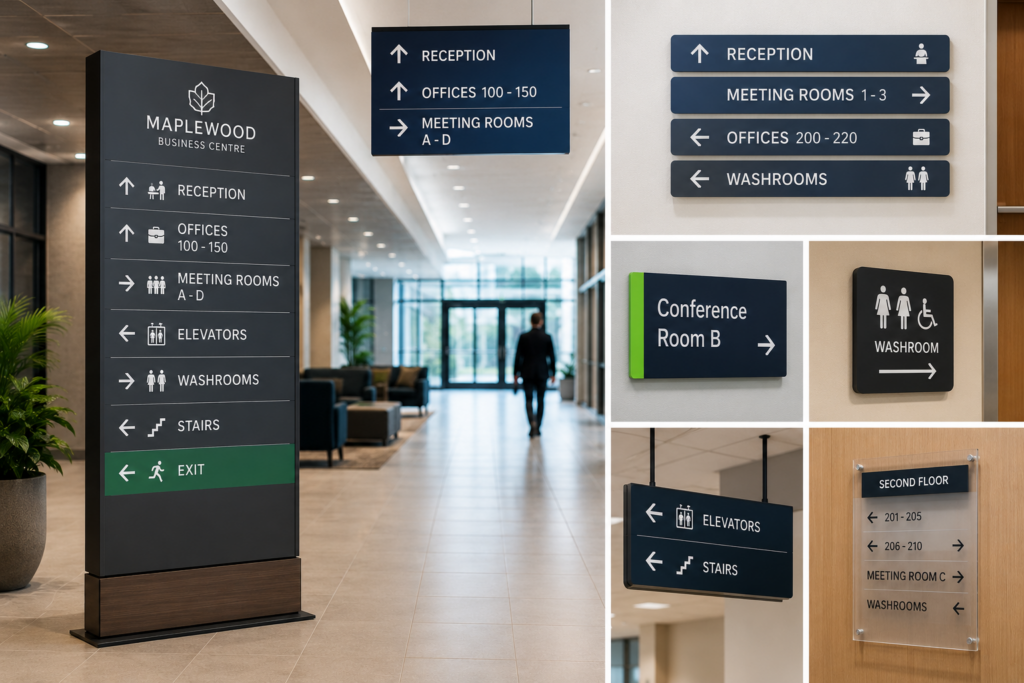
Directional signs are part of a larger wayfinding signage system. They use arrows, words, symbols, colours or a combination of these elements to help people determine where they need to go.
For example, a sign might say:
← Reception
Meeting Rooms –>
↑ Elevators
Washrooms <–
Signs Depot’s wayfinding solutions include directional, identification and informational signs for environments where visitors need clear navigation.
6 Ways Directional Signs Improve Customer Experience
1. Make Your Business Easier to Navigate
Imagine entering a large medical clinic for your first appointment. You see several hallways but don’t know which one leads to reception.
Now imagine immediately seeing:
RECEPTION –
That simple sign removes uncertainty.
Clear navigation is particularly valuable in larger or unfamiliar environments where visitors otherwise have to stop, search or ask employees for assistance.
2. Reduce Customer Frustration
Getting lost isn’t a good first impression.
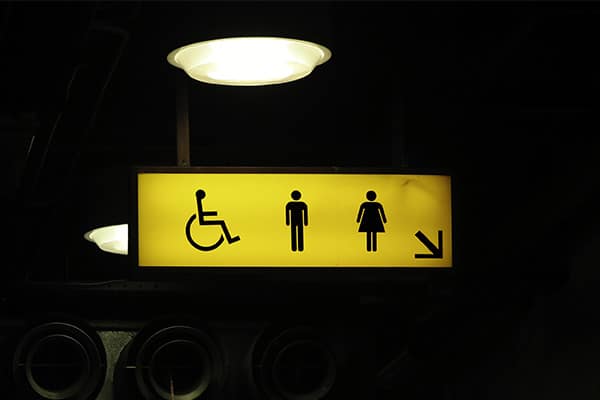
Customers may become frustrated when they can’t locate a department, checkout, washroom or exit. A logical directional signage system provides information at the points where visitors actually need to make decisions.
Example: A retail store could use:
Men’s <– | Women’s ← | Fitting Rooms ↑ | Checkout –>
Customers can spend more time shopping instead of searching for departments.
3. Create a More Professional Environment
Temporary paper signs taped to walls may provide directions, but they don’t necessarily support a polished brand experience.
Custom directional signs can coordinate with your existing interior signs using consistent:
- Colours
- Fonts
- Logos
- Materials
- Icons
- Shapes
Signs Depot specifically identifies wayfinding signs as interior signs that can use simple arrows, symbols and messages to direct visitors between areas.
4. Reinforce Your Brand
Directional signage doesn’t have to look purely functional.
A modern technology company might use acrylic panels, minimalist typography and brand colours. A children’s facility might use colourful graphics and easy-to-recognize icons.
Even wall graphics can become part of the navigation system. Signs Depot notes that wall graphics can guide customers between retail departments or help patients navigate healthcare environments.
Example:
Instead of:
Meeting Rooms –
A company could create a branded wall graphic:
WELCOME TO ABC COMPANY
Reception <— | Meeting Rooms –>
The customer receives directions while continuing to interact with the brand.
5. Help Employees Save Time
Directional signs don’t only benefit customers.
Without clear signage, employees may repeatedly hear:
“Where is the washroom?”
“Where do I check in?”
“Which floor is accounting?”
An effective wayfinding system answers many routine navigation questions automatically, which can reduce interruptions for reception and other employees. Good wayfinding can therefore support both visitor satisfaction and operational efficiency.
6. Improve Navigation Through Large Properties
Directional signage becomes especially important as a property becomes larger or more complicated.
Consider a shopping centre with:
- Multiple entrances
- Underground parking
- Elevators
- Different floors
- Dozens of stores
- Food areas
- Washrooms
One sign at the entrance isn’t enough.
Visitors need guidance throughout their journey.
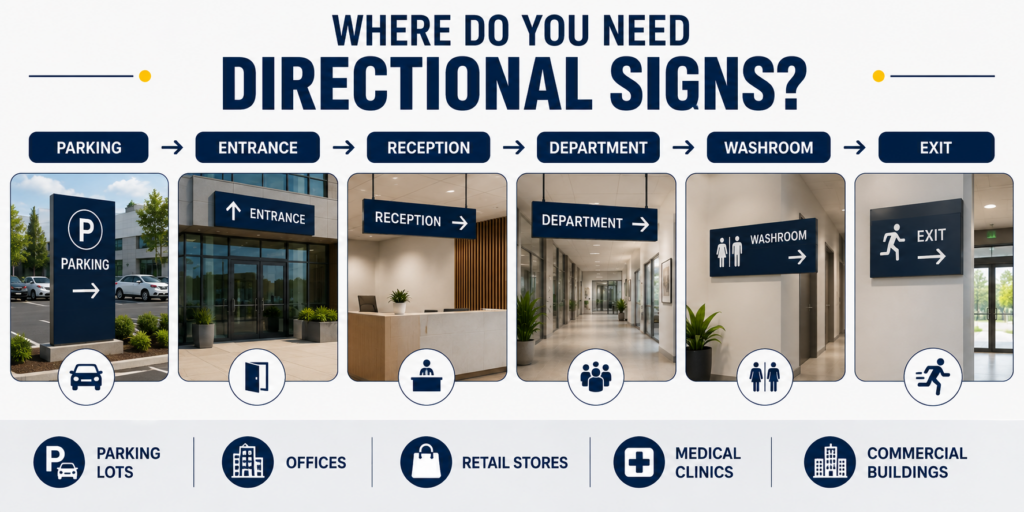
Parking – Entrance – Directory – Store – Washroom – Exit
A complete wayfinding system uses signs at each important decision point rather than expecting one sign to handle the entire journey.
Where Are Directional Signs Used?
Business | Useful Directional Signs |
Medical Clinic | Reception, treatment rooms, washrooms |
Corporate Office | Reception, departments, meeting rooms |
Retail Store | Departments, checkout, fitting rooms |
Restaurant | Entrance, pickup, washrooms |
Shopping Centre | Stores, parking, elevators, exits |
Warehouse | Shipping, receiving, offices, loading |
School | Classrooms, offices, gym, exits |
Hotel | Reception, rooms, elevators, amenities |
For complex environments such as hospitals, malls and transportation facilities, wayfinding signs can combine directional, identification and informational elements to help visitors understand both where to go and when they’ve arrived.
What Makes a Good Directional Sign?
A directional sign should be understood quickly.
Keep the Message Short
Use:
Reception –>
rather than:
Please proceed down this hallway to find our reception area.
Use Easy-to-Recognize Symbols
Icons for washrooms, elevators, stairs, parking and accessibility can communicate information quickly.
Make Text Easy to Read
Choose readable typography and strong contrast between the text and background.
Position Signs Where Decisions Happen
Place signs before intersections, entrances, elevators, hallways and other locations where visitors need to choose their next direction.
Keep the Design Consistent
The same colours, typography, arrow styles and visual system should be used throughout the property. Consistent wayfinding elements can reduce confusion while strengthening the overall brand experience.
Directional Signs Can Be Part of Your Branding
Good signage doesn’t have to choose between function and appearance.
Combine directional signs with custom signs, interior signage and wall graphics to create a consistent experience from the moment customers arrive until they leave.
For example:
Exterior Sign – identifies the business
Reception Sign – reinforces the brand
Directional Signs – guide visitors
Room Signs – confirm destinations
Wall Graphics – add branding and visual interest
Together, these elements create a more organized and professional environment.
FAQs About Wayfinding Signs
What is the purpose of directional signage?
Directional signage helps customers, employees and visitors navigate a property and locate important destinations such as reception areas, departments, washrooms, elevators, parking and exits.
What is the difference between directional and wayfinding signs?
Directional signs are one part of a complete wayfinding system. Wayfinding can also include identification signs, informational signs and other visual elements that help people understand and navigate a space.
Can directional signs include my business branding?
Yes. Colours, fonts, logos, materials and other design elements can be incorporated to make directional signage consistent with your brand.
Where should directional signs be installed?
They should be positioned where visitors need information or need to make a decision, such as entrances, intersections, hallways, elevators, parking areas and reception areas.
Can directional signs be customized?
Yes. Signs Depot provides custom signage solutions that can be designed around a business’s branding and practical requirements.