
A storefront sign is one of the first things customers notice when they approach a business. It helps people identify your company, find your entrance, and understand what type of business you operate.
But one question often comes up when planning a new sign:
How high should a storefront sign be?
There is no single height that works for every storefront. The right position depends on the building, sign size, viewing distance, surrounding businesses, pedestrian traffic, vehicles, and local sign requirements.
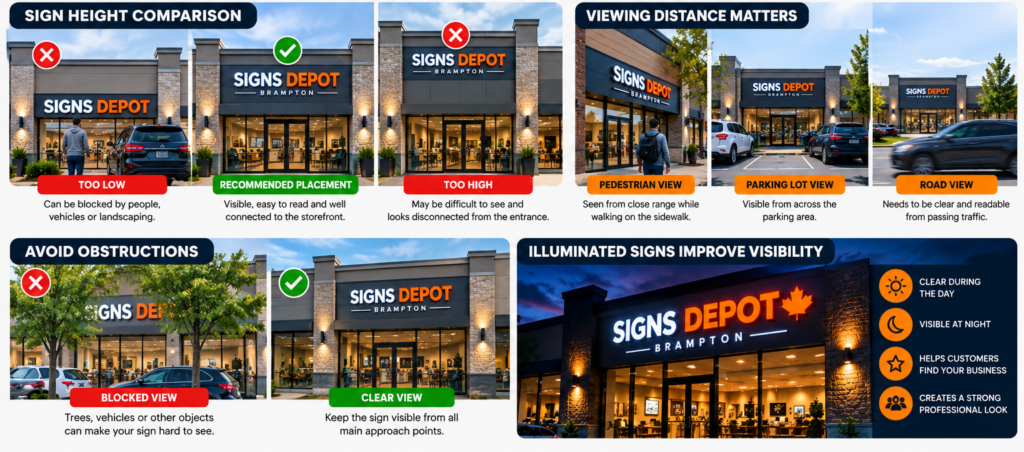
A sign that is too low may be blocked by people, vehicles, landscaping, or other objects. A sign that is too high may be difficult to notice or may not fit naturally with the building.
For businesses in Brampton, the goal should be to find a position where the sign is visible, easy to read, and properly suited to the storefront.
What Is the Best Height for a Storefront Sign?
The best height is usually the one that gives customers a clear view of the sign without making it look out of place on the building.
Instead of choosing a fixed measurement, consider how people approach your business.
Will they see the storefront while:
- Walking along the sidewalk?
- Driving through a parking lot?
- Driving past the property?
- Entering a shopping plaza?
- Standing across the street?
The sign should be positioned within the natural line of sight of your customers.

For many storefronts, placing the sign within the main upper portion of the façade can provide good visibility while keeping the sign visually connected to the entrance and storefront.
1. Consider the Height of Your Building
The building itself plays a major role in determining where a storefront sign should go.
A small one-storey retail unit will have different signage needs from a larger commercial building.
On a smaller storefront, a sign placed too high may look disconnected from the entrance. On a larger building, a sign positioned too low may become difficult to see.
Look at the entire storefront before deciding where the sign should be installed.
The sign should feel like part of the building rather than something simply attached to an empty wall.
2. Think About Viewing Distance
A sign needs to be designed around the distance from which customers will see it.
Someone walking past a shop may see the sign from relatively close range. A driver approaching a commercial property may see it from much farther away.
This affects both sign height and letter size.
If your business is located in a busy commercial area, customers may have only a few seconds to notice your sign. Placing it where it is clearly visible from the main approach can help.
Ask yourself:
“At what point will a customer first see my business?”
That point should be considered when planning the sign’s position.
3. Make Sure the Sign Is Not Blocked
A sign can be at a good height and still be difficult to see if something is blocking it.
Before installation, check for:
- Trees and landscaping
- Parking signs
- Light poles
- Other business signs
- Vehicles
- Awnings
- Building features
- Nearby structures
This is especially important in shopping plazas where several businesses may have signs close to one another.
A professional site assessment can help identify potential visibility problems before the sign is installed.
4. Keep the Sign Connected to the Storefront
Your storefront sign should clearly identify your business location.
Customers should be able to look at the sign and understand that it belongs to the entrance or business directly below it.
If the sign is installed too far away from the storefront, customers may have difficulty connecting the sign with the business.
For this reason, sign placement should be considered together with the:
- Main entrance
- Windows
- Awning
- Building façade
- Business logo
- Storefront colours
A well-planned sign creates a clear visual connection between your branding and your physical location.
5. Consider the Size of the Sign
The size of your sign also affects how high it should be placed.
A large sign may need more surrounding space so it does not overwhelm the building. A smaller sign may need to be positioned carefully so it does not get lost against the storefront.
The sign and its mounting position should work together.
For example, large dimensional letters can create a strong visual presence, but they need enough space around them to remain easy to see.
Similarly, channel letters can be positioned across the upper storefront area to create a clear business name that is visible from a distance.
6. Think About Pedestrian and Vehicle Visibility
The best sign height can be different depending on how customers reach your business.
For a pedestrian-focused location, visibility from the sidewalk and entrance area may be the priority.
For a business located along a busy road or inside a large commercial plaza, visibility from vehicles may be more important.
Think about the main direction from which customers approach.
A storefront sign should be positioned so that customers have enough time to notice and read it before reaching the entrance.
7. Don’t Forget About Letter Size
Sign height and letter size should be planned together.
A sign may be mounted at the right height, but if the letters are too small, customers may still struggle to read it.
Your business name should be the most prominent element.
Avoid filling the sign with too much information. A simple business name and logo can often be more effective than a sign containing several lines of small text.
Good contrast between the lettering and background can also improve readability.
8. Consider Lighting
If your business operates during the evening, think about how the sign will look after dark.
An illuminated storefront sign can help maintain visibility when natural light decreases.
Options such as illuminated channel letters, sign boxes, and halo-lit letters can create different visual effects.
The lighting should help customers see the business name clearly without creating excessive glare.
9. Check Local Sign Requirements
Before deciding on the final height, businesses in Brampton should also check the applicable local sign requirements.
Sign regulations can affect factors such as sign type, size, location, projection, and installation.
The exact requirements can vary depending on the property and type of signage, so it is better to confirm the requirements before manufacturing the sign.
This can help prevent delays or changes after the sign has already been produced.
10. Look at the Sign From Different Angles
Before final installation, try to view the proposed sign location from different positions.
Look at it from:
- The sidewalk
- The parking lot
- The main road
- The building entrance
- Across the street, where applicable
This can help you understand how visible the sign will actually be.
A design that looks perfect when standing directly underneath it may look very different from the road.
What Makes a Storefront Sign Easy to See?
The height of a storefront sign is only one part of effective signage.
A successful storefront sign should also have:
- Clear lettering
- Appropriate letter size
- Good colour contrast
- Strong branding
- Proper lighting when needed
- Good placement
- Suitable materials
- A clear connection to the storefront
When all of these elements work together, the sign can help customers identify your business more quickly.
Get the Right Storefront Sign for Your Brampton Business
So, how high should a storefront sign be?
There is no universal height that works for every business. The right position depends on your building, sign size, viewing distance, customer traffic, surrounding environment, and local requirements.
Instead of choosing a height based only on a standard measurement, consider how your customers will actually see the sign.
A professional signage company can assess the storefront, recommend an appropriate position, and help you choose a sign that fits the building and your brand.
For businesses in Brampton, Signs Depot provides custom signage solutions designed around individual business locations and requirements.
The goal is simple: place your sign where customers can see it, read it, and connect it with your business.