
Digital menu boards in Brampton allow restaurants, cafés, and takeaway businesses to display menus, prices, daily specials, and promotional messages on electronic screens. Unlike printed menus, digital displays can be updated through compatible software, making them useful for businesses that regularly change their offerings.
In 2026, restaurant owners are increasingly evaluating digital displays as part of their customer experience and signage strategy. However, selecting the right system requires careful planning around screen readability, content management, installation, and maintenance.
This guide explores digital menu boards for restaurants, their benefits, common installation mistakes, and practical factors to consider before investing.
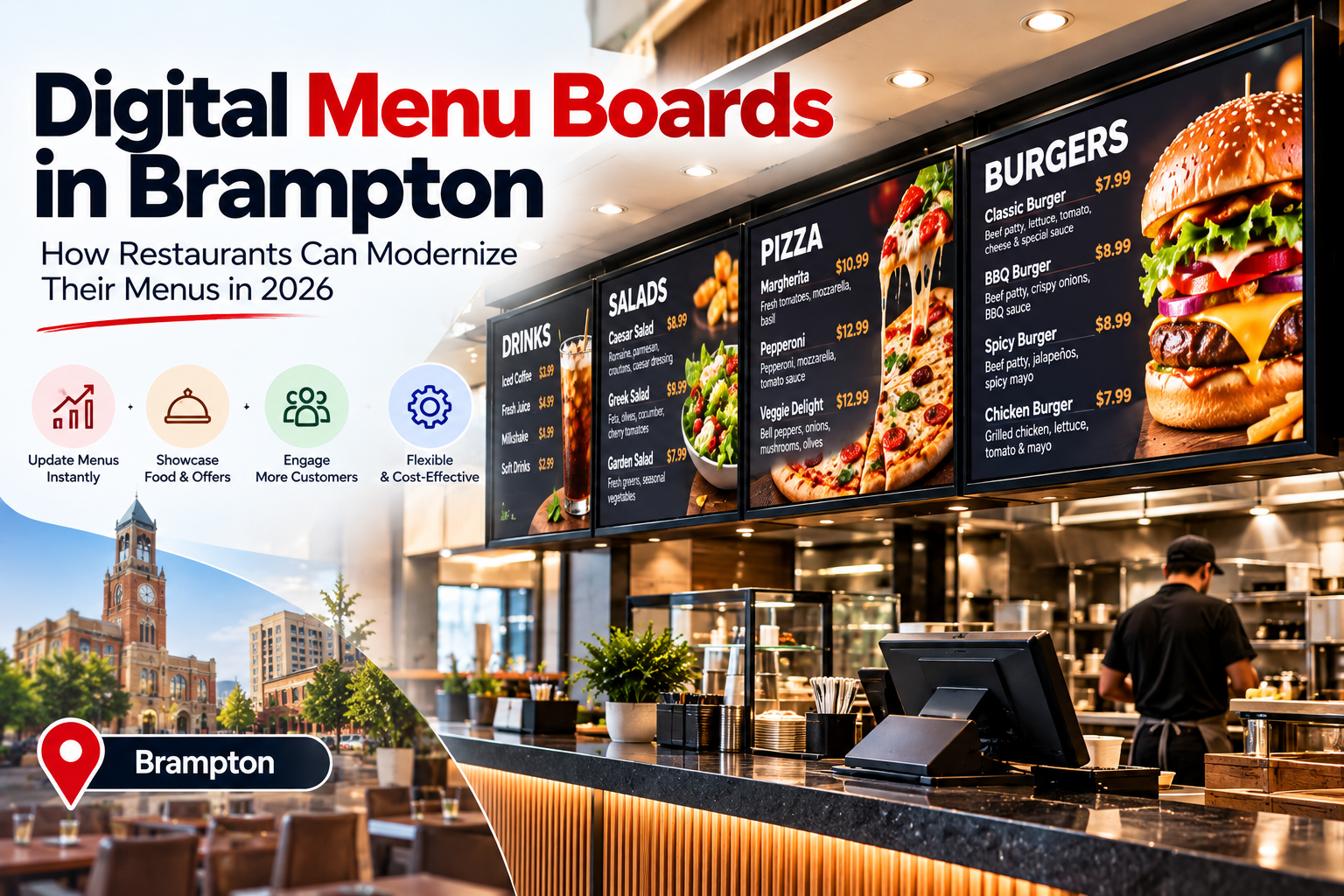
Why Are Restaurants Switching to Digital Menu Boards?
Restaurant menus change for several reasons. Prices may need updating, seasonal items become available, and promotional offers may only run during specific hours.
Printed menu boards can require replacement whenever significant changes occur.
A digital menu system provides greater flexibility when it uses suitable software and compatible equipment.
Benefits of Digital Menu Boards for Restaurants
- Faster menu updates: Change prices, product descriptions, and availability without printing replacement boards.
- Daypart scheduling: Display breakfast, lunch, and dinner menus at scheduled times.
- Visual merchandising: Highlight food photography and featured products.
- Consistent branding: Present coordinated menu designs across multiple screens.
- Improved communication: Display allergen notices, service information, and promotional messages where appropriate.
The main benefit is not simply making a restaurant look modern. It is providing clear information while making menu management more convenient.
1. Which Digital Menu Board Technology Is Best for Your Restaurant?
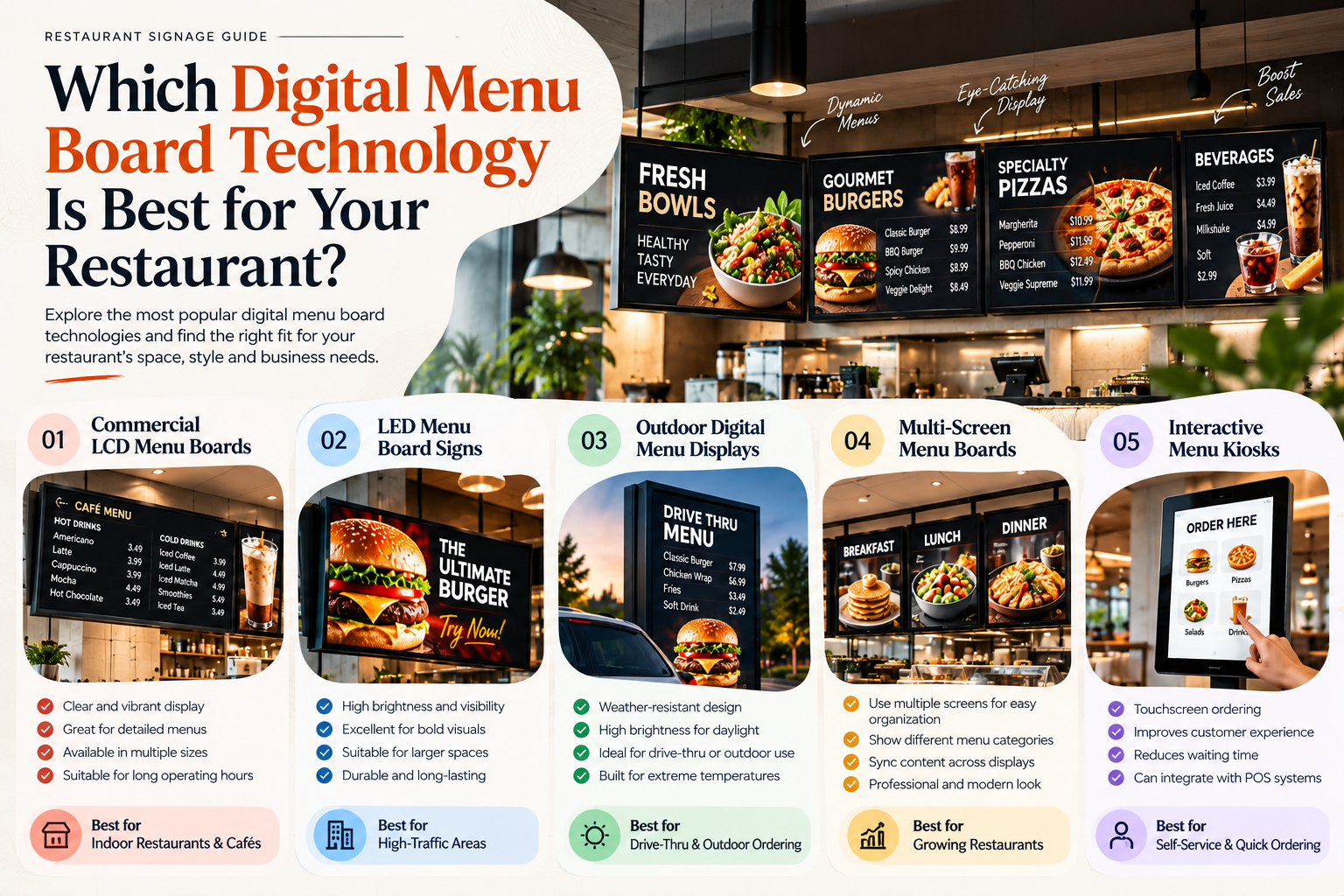
Different types of electronic menu boards serve different restaurant environments.
An indoor café generally has different requirements from an outdoor drive-through location.
Display type | Suitable application | Important consideration |
Commercial LCD screen | Indoor restaurant menu | Readability and operating hours |
LED display | Larger viewing areas | Pixel pitch and viewing distance |
Outdoor-rated display | Exterior ordering area | Weather and temperature protection |
Multi-screen menu | Quick-service counter | Content synchronization |
Touchscreen kiosk | Self-service ordering | Accessibility and integration |
Commercial LCD Displays
Commercial LCD displays are commonly used indoors because they can show detailed menus, photographs, and promotional content.
Restaurant owners should compare brightness, screen size, expected operating hours, and warranty coverage.
LED Menu Board Signs
LED menu board signs can be useful where larger-format displays or different viewing distances are required.
However, not every LED display is suitable for detailed menu text. Pixel pitch, resolution, and viewing distance affect how clearly customers can read pricing and product descriptions.
Outdoor Digital Displays
Outdoor menu displays require equipment designed for the installation environment.
Brampton experiences cold winters, summer heat, rain, and snow. An outdoor system should have suitable environmental protection and temperature-management features.
2. Where Should Digital Restaurant Menu Displays Be Installed?
Placement strongly affects the usefulness of digital restaurant menu displays.
Customers should be able to understand the menu before reaching the ordering point.
Screens placed too high, too far away, or behind reflective surfaces may create readability problems.
Recommended Display Locations
Above the ordering counter: Suitable for quick-service restaurants where customers select meals before ordering.
Near the entrance: Useful for showcasing signature products, promotions, or limited-time offers.
Inside the dining area: Can communicate additional services, announcements, or upcoming promotions.
At an outdoor ordering point: May support drive-through or takeaway operations when appropriate equipment and approvals are available.
Restaurant owners should also consider how digital displays complement permanent exterior branding.
For example, commercial sign boxes can identify a restaurant or reinforce brand visibility, while an electronic menu handles frequently changing information.
3. How Should Restaurants Design Digital Menus That Customers Can Read?
A digital menu board should prioritize clarity over animation.
Bright colours and moving graphics may attract attention, but too much movement can make essential information difficult to follow.
Use a Clear Visual Hierarchy
Organize menu content in a logical order:
- Menu categories
- Product names
- Short descriptions
- Prices
- Promotional highlights
Use readable typography, suitable contrast, and consistent spacing.
Avoid Overcrowding
Trying to fit an entire restaurant menu onto one screen can reduce readability.
Where practical, divide categories between screens or use scheduled content.
Use Quality Food Photography
Photographs should accurately represent the products being sold.
Clear, consistent product images can help customers recognize featured menu items.
Keep Prices Accurate
If prices change, update all relevant displays promptly.
A restaurant should also ensure that any advertised offers, restrictions, and required information are clearly presented.
4. How Much Do Digital Menu Boards Cost in Brampton?
The price of a restaurant digital signage system depends on its specifications and installation requirements.
There is no single reliable price for every restaurant.
Main Factors Affecting Cost
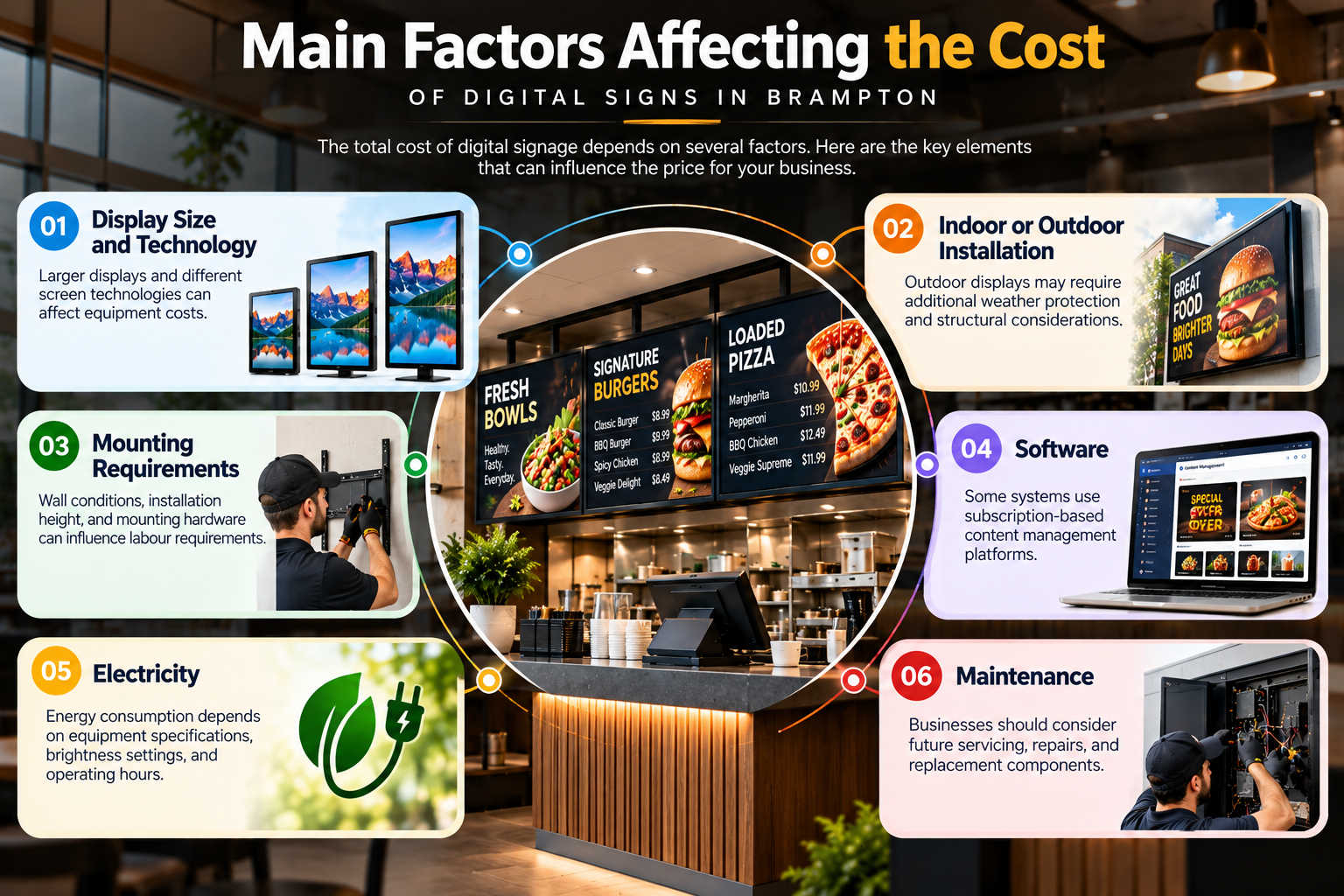
Cost factor | What influences the expense? |
Screen size | Larger displays and display technology |
Number of screens | Equipment and synchronization requirements |
Installation | Mounting, electrical work, cable routing |
Software | Subscription and management features |
Content design | Templates, photography, menu organization |
Maintenance | Repairs, support, replacement components |
A restaurant should also evaluate electricity usage and expected equipment lifespan.
Total ownership cost = Equipment + Installation + Software + Content preparation + Electricity + Maintenance
This calculation provides a better basis for comparing quotations than the initial screen price alone.
5. Digital Menu Boards vs. Printed Restaurant Menus
Both digital and printed signage can serve restaurants effectively.
The correct choice depends on how frequently information changes and how the restaurant communicates with customers.
Feature | Digital menu board | Printed menu board |
Price updates | Software-based updates | Physical replacement may be needed |
Animation | Supported on compatible systems | Not supported |
Electricity | Required | Generally not required |
Purchase cost | Often higher | Often lower |
Ongoing needs | Software and equipment maintenance | Reprinting and physical upkeep |
Ideal use | Frequently changing menus | Stable menus and permanent information |
Many restaurants benefit from combining both methods.
For instance, a restaurant might use digital screens for rotating promotions and printed signage for permanent branding or customer directions.
Businesses planning a coordinated storefront can also consider channel letter signs for exterior identification.
6. Digital Menu Board Trends to Watch in 2026
Modern restaurant digital signage increasingly emphasizes practical software features rather than visual effects alone.
Daypart Menu Scheduling
Compatible systems can automatically switch between breakfast, lunch, and dinner menus.
This can reduce the need for employees to update displays manually.
Centralized Content Management
Restaurant groups may manage several compatible displays using a shared software platform.
Inventory-Connected Updates
Some advanced systems can integrate with restaurant software to update availability information.
Compatibility, integration costs, and reliability should be confirmed before purchasing.
Promotional Content Rotation
Restaurants may use scheduled displays to highlight seasonal products, featured meals, or limited-time offers.
The most useful features are those that reduce operational work and improve customer communication.
7. Seven Questions to Ask Before Buying Restaurant Digital Signage
Before choosing a system, restaurant owners should ask:
- How many screens are necessary for the menu?
- Will customers be able to read the menu from the ordering area?
- Can staff update prices and products easily?
- Does the equipment support the restaurant’s daily operating hours?
- What happens if the internet connection fails?
- Which installation, software, and maintenance expenses are included?
- Are building-owner approvals or municipal permits required?
A structured consultation can help determine which technology is appropriate for the available space and budget.
If your restaurant also needs promotional window branding, explore custom window graphics for complementary storefront applications.
Frequently Asked Questions About Digital Menu Boards
Are digital menu boards suitable for small restaurants?
Yes. A small restaurant can use one appropriately sized display for its menu or promotions. The benefits should be weighed against installation and operating costs.
Can restaurant owners update menu prices remotely?
Many digital signage platforms support remote content management. The available features depend on the software, hardware, and network setup.
Do digital menu boards require an internet connection?
Requirements vary. Some systems can continue displaying locally stored content offline, while remote updates and cloud features may require internet access.
Are LED menu boards suitable for outdoor use?
Only equipment rated for the intended outdoor environment should be installed outside. Weather protection, operating temperature, brightness, and mounting requirements must be considered.
Can a restaurant display different menus throughout the day?
Yes. Compatible content management systems can schedule breakfast, lunch, dinner, and promotional menus automatically.
Do restaurants need permits for digital signs in Brampton?
Requirements depend on the installation location and applicable regulations. Restaurant owners should confirm exterior sign requirements with the City of Brampton and their property manager.
Plan Your Restaurant Signage with Signs Depot in Brampton
A professional restaurant needs more than an attractive menu. Customers should be able to identify the business, locate its entrance, understand available services, and navigate the space comfortably.
Signs Depot is a Brampton-based signage company offering custom exterior and interior signage solutions, design consultation, production, permitting assistance, and installation services.
Restaurant owners planning a signage upgrade can discuss their branding, storefront visibility, and installation requirements with the Signs Depot team.
For specific digital menu screen systems, confirm product availability and technical capabilities directly before requesting a quotation.
Ready to Upgrade Your Restaurant Signage?
Whether you are opening a café, renovating a restaurant, or improving your storefront branding, professional signage planning can help create a clearer, more consistent customer experience.
Call 647-763-9173 or email info@signsdepot.com to discuss your signage requirements.
Request a Quote from Signs Depot
Make your restaurant easier to recognize with signage designed around your business, location, and customers.